
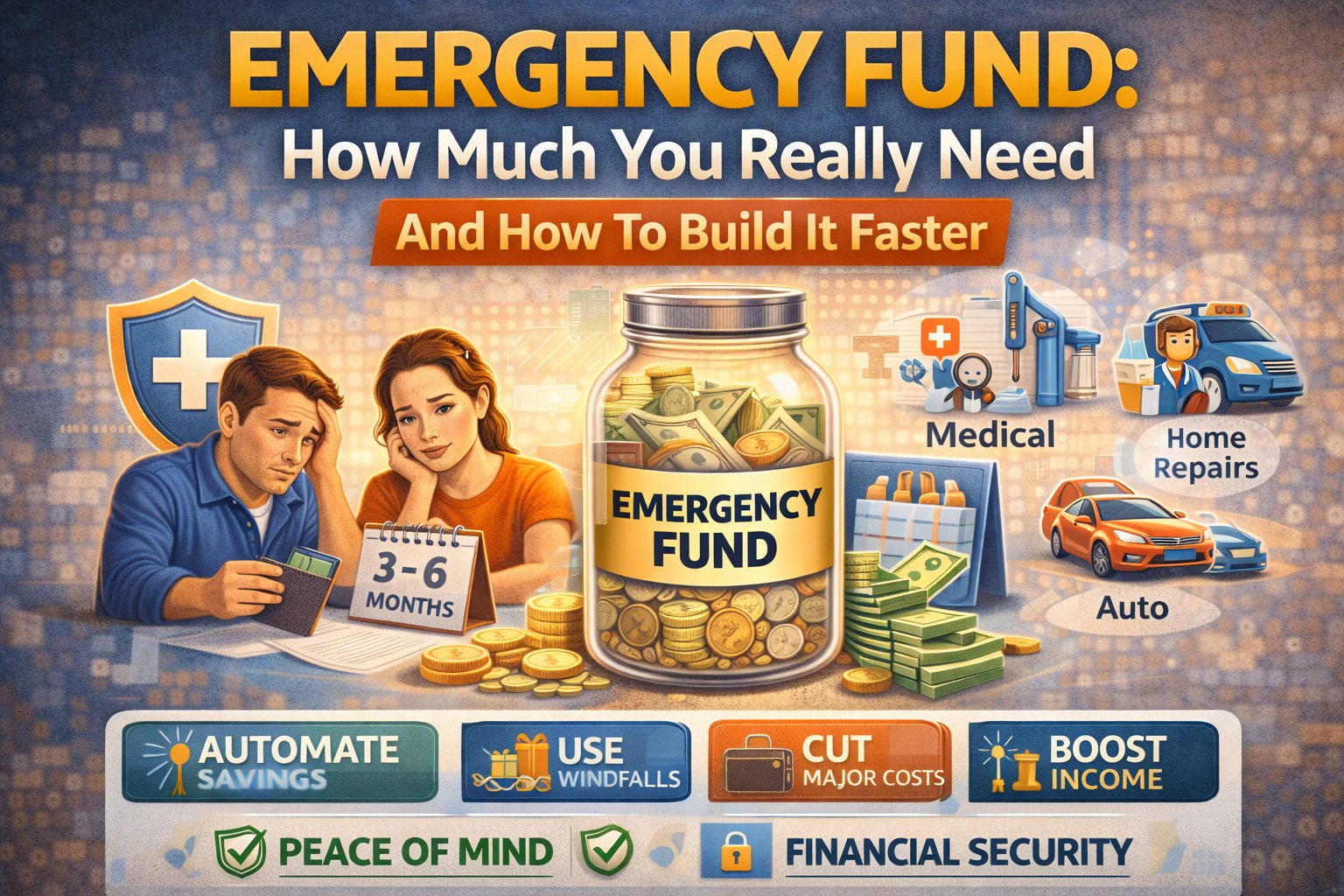
Emergency Fund: How Much You Really Need and How to Build It Faster
Introduction
Let me ask you something honestly.
If you lost your income tomorrow, how long could you survive without borrowing money?
One week?
One month?
Or would you immediately depend on credit cards, loans, or family?
This is exactly why an emergency fund is not optional anymore — especially in 2026.
With rising inflation, unstable job markets, medical costs, and unexpected expenses, having savings is no longer just “good financial advice.” It’s financial protection.
But here’s where most people get confused:
-
How much emergency fund do you really need?
-
Is 3 months enough?
-
Should it be 6 months?
-
What if your income is low?
-
And most importantly — how do you build it faster?
In this guide, we’ll break down Emergency Fund: How Much You Really Need and How to Build It Faster in a simple, human, practical way — no complicated financial jargon.
What Is an Emergency Fund?
An emergency fund is money set aside only for unexpected situations like:
-
Job loss
-
Medical emergencies
-
Car repairs
-
Urgent home repairs
-
Family emergencies
-
Sudden travel needs
It is NOT for:
-
Shopping
-
Vacations
-
Upgrading your phone
-
Random “sales”
Think of your emergency fund as your personal financial safety net.
Without it, even a small problem becomes a big financial crisis.
Why an Emergency Fund Is More Important in 2026
Let’s be realistic.
In 2026:
-
Living costs are high
-
Rent and groceries are expensive
-
Healthcare costs are rising
-
Job markets are competitive
Financial stability is fragile.
One unexpected event can push someone into debt for years.
In my opinion, building an emergency fund is more important than investing when you are starting your financial journey.
Because investments grow money.
Emergency funds protect money.
Protection comes first.
How Much Emergency Fund Do You Really Need?
Now we answer the main question in this guide:
Emergency Fund: How Much You Really Need and How to Build It Faster
The traditional advice says:
Save 3 to 6 months of living expenses.
But let’s break it down realistically.
Step 1: Calculate Your Monthly Essentials
Only count necessities:
-
Rent or mortgage
-
Groceries
-
Utilities
-
Transportation
-
Insurance
-
Minimum loan payments
Ignore wants like entertainment or dining out.
Let’s say your essential monthly expenses are $1,500.
Step 2: Multiply by 3 to 6 Months
$1,500 × 3 = $4,500
$1,500 × 6 = $9,000
So ideally, your emergency fund should be between $4,500 to $9,000.
But here’s my honest opinion:
If that number feels overwhelming, don’t panic.
Start small.
Start with a Mini Emergency Fund First
Before targeting 3–6 months, aim for:
$500 to $1,000
This small emergency fund covers:
-
Minor repairs
-
Small medical bills
-
Unexpected short expenses
In my experience, having even $500 saved changes your mindset completely.
You feel safer.
You stress less.
You stop relying on credit cards.
Small wins build confidence.
Who Needs 6+ Months of Emergency Fund?
Some people need more than 3 months.
You may need 6 months or more if:
-
You have dependents
-
Your job is unstable
-
You are self-employed
-
You are the only income earner
-
Your industry is unpredictable
In 2026, many freelancers and gig workers should aim for 6 months minimum.
Security is more important than speed.
How to Build Your Emergency Fund Faster
Now let’s focus on the second part of this guide:
How to Build It Faster
This is where practical action matters.
1. Open a Separate Savings Account
Never mix emergency fund money with daily spending.
Keep it separate.
If possible, open a high-interest savings account so your money grows slightly while staying accessible.
Out of sight = less temptation.
2. Automate Your Savings
Automation removes excuses.
Set automatic transfers right after salary comes.
Even:
-
$50 per week
-
$100 per month
Consistency builds momentum.
3. Use Windfalls Wisely
Tax refunds
Bonuses
Freelance payments
Gifts
Instead of spending everything, allocate 50% to your emergency fund.
Windfalls accelerate savings.
4. Cut One Major Expense Temporarily
Instead of cutting 10 small things, cut one big expense:
-
Move to cheaper housing
-
Share accommodation
-
Cancel unused subscriptions
-
Reduce dining out
Temporary sacrifice creates long-term safety.
5. Sell Unused Items
Look around your house.
Old electronics
Unused furniture
Clothes
Accessories
Selling unused items can jumpstart your emergency fund quickly.
6. Start a Small Side Income
If saving feels too slow, increase income.
Even an extra $200 per month can dramatically speed up your emergency fund goal.
In 2026, online work opportunities make side income more accessible than ever.
Where Should You Keep Your Emergency Fund?
Emergency funds must be:
-
Safe
-
Liquid
-
Easily accessible
Do NOT invest emergency funds in:
-
Stocks
-
Crypto
-
High-risk assets
Because emergencies don’t wait for markets to recover.
Safety is priority.
Common Emergency Fund Mistakes
If you’re serious about building financial stability, avoid these mistakes:
-
Investing emergency fund money
-
Spending it on non-emergencies
-
Waiting for “perfect income” to start
-
Trying to build 6 months immediately
-
Not rebuilding after using it
Emergency funds must be protected.
My Personal Experience with an Emergency Fund
I’ll be honest.
There was a time when I didn’t have an emergency fund.
When unexpected expenses came, I used credit cards.
That created stress.
Interest payments.
Sleepless nights.
Financial pressure.
The day I built my first $1,000 emergency fund was the day my financial anxiety reduced.
Not because I became rich.
But because I became protected.
Now I treat my emergency fund like insurance.
I hope I never use it.
But I’m grateful it’s there.
Is an Emergency Fund More Important Than Investing?
In my opinion — yes, at the beginning.
Without emergency savings:
-
You withdraw investments during crises
-
You take loans
-
You damage long-term wealth
Emergency funds create stability.
Investments create growth.
Stability must come first.
What If You Have Debt?
Build a small $500–$1,000 emergency fund first.
Then focus on high-interest debt.
After clearing debt, expand your emergency fund to 3–6 months.
Balance is key.
Final Conclusion: How Much You Really Need and How to Build It Faster
So, let’s summarize:
How much emergency fund do you really need?
-
Minimum: $500–$1,000 (starter fund)
-
Ideal: 3–6 months of essential expenses
-
More if income is unstable
How to build it faster?
-
Automate savings
-
Cut one major expense
-
Use windfalls wisely
-
Increase income gradually
In 2026, financial uncertainty is real.
An emergency fund is not luxury.
It is protection.
You don’t build it overnight.
You build it step by step.
And trust me — the peace of mind is worth it.
Frequently Asked Questions (FAQs)
1. How much emergency fund should I have in 2026?
Ideally 3–6 months of essential expenses. Start with $500–$1,000 if that feels overwhelming.
2. Where should I keep my emergency fund?
In a separate, safe, high-interest savings account that allows easy access.
3. Should I invest my emergency fund?
No. Emergency funds must remain safe and liquid.
4. How long does it take to build an emergency fund?
It depends on income and savings rate. Most people can build a starter fund within 3–6 months.
5. Can I use my emergency fund for vacations?
No. It is strictly for unexpected financial emergencies.