
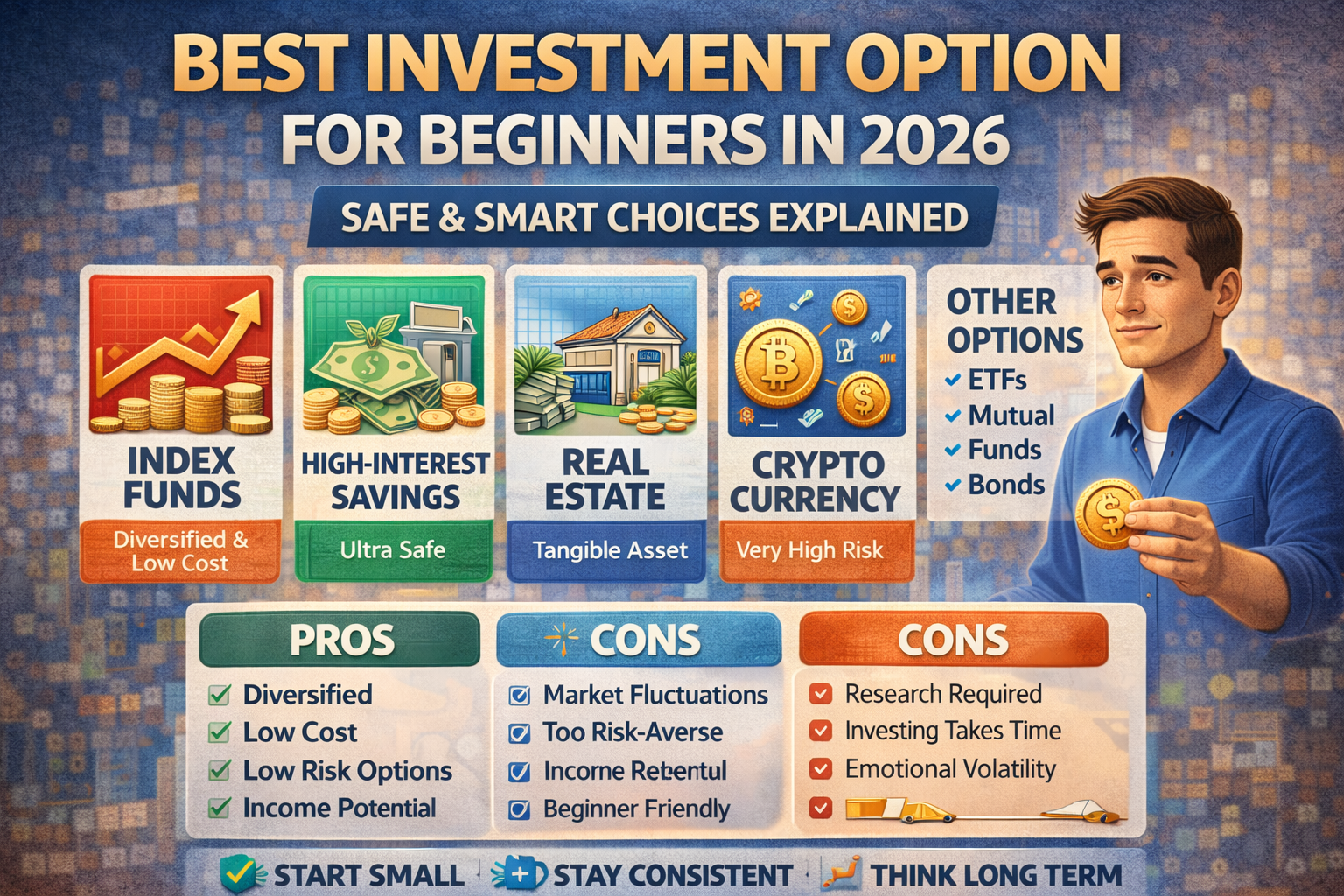
Best Investment Option for Beginners in 2026: Complete Guide for Smart Investors
Introduction
Let’s be honest.
If you are a beginner in 2026, investing feels confusing.
There are:
-
Stocks
-
Crypto
-
Mutual funds
-
ETFs
-
Real estate
-
Gold
-
AI-based apps
Everyone claims their method is the best.
But as a beginner, you don’t need hype.
You need clarity.
You need safety.
You need something practical.
So today, we will answer one important question in detail:
What is the best investment option for beginners in 2026?
And we won’t just give one random answer. We will break down options, pros and cons, risks, and real-life practicality.
Because beginners don’t lose money due to lack of opportunity.
They lose money due to lack of understanding.
Let’s fix that.
Before Investing: 3 Things Beginners Must Do
Before searching for the best investment option for beginners in 2026, make sure you:
-
Have an emergency fund (3–6 months of expenses)
-
Clear high-interest debt
-
Understand your risk tolerance
In my opinion, investing without emergency savings is like building a house without foundation.
Safety first. Growth later.
So, What Is the Best Investment Option for Beginners in 2026?
If I had to choose one single best investment option for beginners in 2026, it would be:
Index Funds (Especially S&P 500 Index Funds)
Now let’s understand why.

1. Index Funds – The Safest Start for Beginners
An index fund is a type of mutual fund or ETF that tracks a market index like:
-
S&P 500
-
Total Stock Market
-
Global Market Index
Instead of picking individual stocks, you invest in the entire market.
This reduces risk.
Why Index Funds Are the Best Investment Option for Beginners in 2026
1. Diversification
You’re not investing in one company.
You’re investing in hundreds.
If one company fails, others balance it.
This is powerful protection for beginners.
2. Low Cost
Index funds usually have very low fees.
Lower fees = more profit stays with you.
Over 20 years, fees make a massive difference.
3. No Stock Picking Stress
Beginners often lose money trying to pick “the next big stock.”
Index funds remove this pressure.
You simply invest consistently.
4. Historically Strong Returns
Over long periods, major indexes have averaged around 7–10% annually.
While past performance doesn’t guarantee future returns, history shows strong long-term growth.
Pros of Index Funds
-
Simple to understand
-
Low risk compared to individual stocks
-
Low fees
-
Great for long-term wealth
-
No daily management needed
-
Ideal for passive investing
Cons of Index Funds
-
Market fluctuations still affect returns
-
No quick-rich potential
-
Requires patience
-
Short-term volatility
In my opinion, the “slow and steady” nature is actually an advantage for beginners.
2. High-Interest Savings Accounts (For Ultra Beginners)
If someone is extremely risk-averse, high-interest savings accounts are a beginner-friendly option.
They offer:
-
Safety
-
Guaranteed returns
-
Liquidity
But returns are lower than stock market investments.
Pros
-
No risk of losing principal
-
Easy access to money
-
Perfect for short-term goals
Cons
-
Returns barely beat inflation
-
Not ideal for long-term wealth building
This is good for beginners afraid of market risk.
3. ETFs (Exchange-Traded Funds)
ETFs are similar to index funds but trade like stocks.
They are flexible and beginner-friendly.
Pros
-
Diversification
-
Lower fees
-
Easy buying/selling
-
Transparent
Cons
-
Market volatility
-
Requires brokerage account
In 2026, ETFs remain one of the best investment options for beginners due to accessibility and flexibility.
4. Mutual Funds
Actively managed funds where professionals pick stocks.
Pros
-
Professional management
-
Diversification
-
Good for hands-off investors
Cons
-
Higher fees
-
Performance may not beat index funds
For beginners, index funds often outperform many actively managed funds over long periods.
5. Real Estate (Not Always Beginner Friendly)
Real estate sounds attractive.
But in 2026, high property prices make entry difficult.
Pros
-
Tangible asset
-
Rental income
-
Inflation protection
Cons
-
High capital required
-
Maintenance costs
-
Illiquidity
-
Market risk
Real estate is powerful but not always the best investment option for beginners in 2026 due to high entry barriers.
6. Cryptocurrency (High Risk for Beginners)
Crypto is popular.
But for beginners?
Very risky.
Pros
-
High return potential
-
Innovative technology
Cons
-
Extreme volatility
-
Regulatory uncertainty
-
Emotional stress
In my honest opinion, beginners should not start their investment journey with crypto.
Learn stability first.
My Personal Opinion: What I Would Choose in 2026
If I were starting again in 2026 as a beginner:
-
Build emergency fund
-
Invest 70–80% into index funds
-
Keep 10–20% for experimentation
Why?
Because wealth is built through consistency, not excitement.
I’ve seen beginners chase “hot stocks” and lose confidence after losses.
Index funds reduce emotional mistakes.
That’s why I believe they remain the best investment option for beginners in 2026.
How Beginners Should Start Investing in 2026
Step-by-step:
-
Open brokerage account
-
Choose low-cost index fund
-
Start with small amount
-
Invest monthly
-
Ignore short-term market noise
Consistency > Timing the market.
Common Beginner Investment Mistakes
Avoid these:
-
Trying to time the market
-
Investing without emergency fund
-
Following social media hype
-
Checking portfolio daily
-
Panic selling during market dips
Discipline builds wealth.
Emotion destroys it.
How Much Should Beginners Invest?
Start small.
Even:
-
$50 per month
-
$100 per month
The key is consistency.
Compound growth works over time.
Example:
$200 monthly invested at 8% annually for 20 years becomes significant wealth.
Time is powerful.
Long-Term vs Short-Term Thinking
Beginners must think long term.
Investing is not gambling.
It’s not quick money.
It’s a slow wealth-building machine.
The earlier you start, the easier it becomes.
Final Conclusion: Best Investment Option for Beginners in 2026
After analyzing all options, here’s the honest answer:
The best investment option for beginners in 2026 is low-cost index funds.
Why?
-
Diversification
-
Simplicity
-
Low cost
-
Proven long-term growth
-
Reduced emotional mistakes
You don’t need complicated strategies.
You need:
-
Consistency
-
Patience
-
Discipline
Start small.
Stay consistent.
Think long term.
That’s how beginners become wealthy investors.
Frequently Asked Questions (FAQs)
1. What is the safest investment for beginners in 2026?
High-interest savings accounts are safest, but index funds offer better long-term growth with manageable risk.
2. How much money do I need to start investing?
Many platforms allow starting with as little as $50–$100.
3. Are index funds better than individual stocks for beginners?
Yes. They offer diversification and lower risk compared to single stocks.
4. Should beginners invest in crypto?
Only a small portion after building stable investments. Crypto is high risk.
5. How long should beginners invest?
At least 5–10 years. Investing works best long term.